Acetone (Propanone, 2-Propanone) About
| Purity |
99% |
| Grade Standard |
Industrial Grade |
| Physical State |
Liquid |
| Packaging Details |
25 litres Drum |
| Usage/Application |
Industrial Equipment Cleaning |
| CAS No |
67-64-1 |
| Chemical Formula |
CH3)2CO |
| Color |
White |
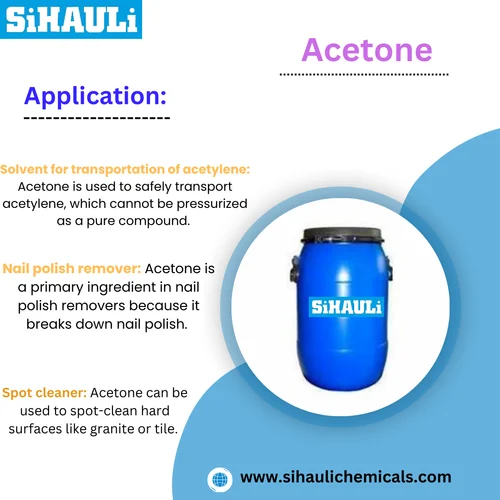
Acetone is a manufactured chemical that is also found naturally in the environment. It is a colorless liquid with a distinct smell and taste. It evaporates easily, is flammable, and dissolves in water. It is also called dimethyl ketone, 2-propanone, and beta-ketopropane.
Versatile Industrial SolventAcetone stands out due to its high purity (99.5%) and excellent miscibility with water and other solvents. This makes it ideal for applications in pharmaceuticals, coatings, paints, adhesives, and laboratory practices. Its characteristic sweet odor, fast evaporation rate, and neutral pH further enhance its usability across diverse industries.
Safe Handling and StorageGiven its high flammability (flash point: -20C) and vapor pressure, acetone must be stored in a cool, dry, and well-ventilated area, away from ignition sources. Proper storage ensures product stability and safety, with a shelf life of up to 24 months in appropriately sealed containers such as drums, bottles, and cans.
Key Specifications & BenefitsAcetone is supplied as a colorless liquid with a density of 0.791 g/cm3 and a very low viscosity. It boasts quick evaporation, offering rapid drying for surface cleaning and solvent tasks. Its molecular weight is 58.08 g/mol, and it has a melting point of -95C and boiling point of 56C, making it adaptable for various industrial needs.
FAQ's of Acetone (Propanone, 2-Propanone):
Q: How should acetone be safely stored in industrial settings?
A: Acetone must be kept in tightly sealed containers within a cool, dry, and well-ventilated environment, away from heat, sparks, and open flames. Proper storage maximizes its 24-month shelf life and minimizes fire hazards.
Q: What are the primary industrial uses of acetone?
A: Acetone is predominantly used as a solvent in pharmaceuticals, paints, coatings, adhesives, and laboratory procedures. It also functions effectively as a cleaning agent and as a raw material in various chemical manufacturing processes.
Q: When is acetone preferred over other solvents?
A: Acetone is ideal when rapid evaporation and strong solvency are required, such as in laboratory cleaning, paint thinning, or when preparing surfaces for adhesives. Its neutrality and high miscibility make it a reliable choice for many applications.
Q: Where can acetone containers be sourced, and in which sizes?
A: Manufacturers, exporters, importers, and suppliers across India offer acetone in packaging such as drums, bottles, and cans, with available sizes including 1L, 5L, 25L, and 200L to meet various user requirements.
Q: What safety measures should be followed when handling acetone?
A: Since acetone is highly flammable and causes serious eye irritation, users should avoid sparks, wear protective eyewear, and work in ventilated areas. Refer to hazard class and UN number 1090 for compliance.
Q: How does acetone benefit cleaning and laboratory applications?
A: Acetone's very fast evaporation rate and strong solvency enable efficient residue removal and quick surface preparation, making it invaluable for cleaning glassware and dissolving contaminants in labs and industrial settings.
Q: What is the benefit of acetone's high purity (99.5%) in industrial use?
A: High purity ensures consistent performance in sensitive applications, prevents contamination, and delivers optimal results in pharmaceutical, laboratory, and manufacturing processes.





 Send Inquiry

