Camphene ( Camphine) About
Camphene is a bicyclic organic compound. It is one of the most pervasive monoterpenes. As with other terpenes, it is insoluble in water, flammable, colorless, and has a pungent smell.[4] It is a minor constituent of many essential oils such as turpentine, cypress oil, camphor oil, citronella oil, neroli, ginger oil, valerian, and mango.[5] It is produced industrially by isomerization of the more common alpha-pinene using a solid acid catalyst such as titanium dioxide.Key Properties and ApplicationsCamphene appears as white, translucent crystals with a pungent, camphor-like odor. It is mainly used in the fragrance and resin industries and as a plasticizer. With a melting point of 51-52C and a boiling point of 159C, Camphene is notable for its volatility and low water solubility. Its molecular structure (C10H16) contributes to its utility in industrial and laboratory settings.
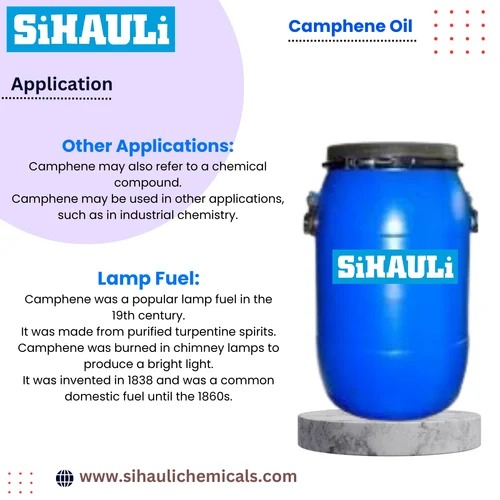
Safe Handling and Storage GuidelinesCamphene should be stored in tightly closed containers such as HDPE or iron drums in a cool, dry, and well-ventilated area. Since it has a flash point of 36C and is an irritant, appropriate personal protective equipment is recommended. Its stability ensures a shelf life of up to 2 years if stored according to recommended guidelines, but keep it away from strong oxidizing agents to avoid hazardous reactions.
FAQ's of Camphene ( Camphine):
Q: How should Camphene be stored to ensure its stability and shelf life?
A: Camphene should be stored in tightly closed HDPE or iron drums, kept in a cool, dry, and well-ventilated area. Proper storage under these conditions ensures the compound remains stable and maintains a shelf life of up to 2 years.
Q: What are the primary industrial uses of Camphene?
A: Camphene is mainly used in manufacturing fragrances, resins, and as a plasticizer. Its unique scent and chemical properties make it suitable for use in perfumery, polymer industries, and as a chemical intermediary.
Q: When handling Camphene, what safety precautions should be taken?
A: As Camphene is classified as an irritant, it is important to use personal protective equipment such as gloves and goggles during handling. Work in a well-ventilated area and avoid contact with strong oxidizing agents to minimize risks.
Q: Where is Camphene typically supplied and in what packaging forms?
A: Camphene is typically supplied by exporters, importers, manufacturers, and suppliers in India. It is available in HDPE drums, iron drums, or can be custom-packed according to client requirements.
Q: What is the benefit of using Camphene in industrial processes?
A: Camphene offers a high degree of purity and is valued for its distinctive odor and versatility as a chemical intermediate. Its use in fragrances and resins provides desirable sensory attributes and functional performance in finished products.
Q: How is Camphene identified and classified chemically?
A: Camphene is a crystalline solid with the molecular formula C10H16, structurally known as 2,2-Dimethyl-3-methylenebicyclo[2.2.1]heptane. It is classified as a terpene hydrocarbon under the HS Code 29061900.





 Send Inquiry

