Carnauba Wax IP About
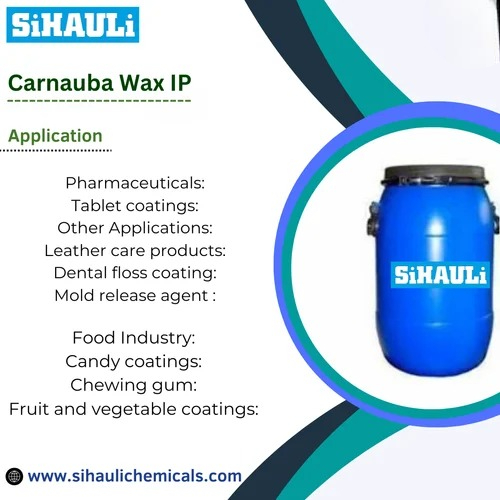
Carnauba wax is primarily used in the cosmetic industry for its ability to provide a hard, glossy finish, making it a key ingredient in products like lipsticks, lip balms, mascara, eyeliners, foundations, and other skincare items due to its high melting point and water-resistant properties; it is also utilized in car waxes, furniture polishes, and as a coating for pharmaceutical tablets due to its protective and hardening capabilities. Superior Purity and Safety StandardsOur Carnauba Wax IP is sourced and manufactured under stringent quality controls, meeting Indian Pharmacopoeia (IP) standards. It is completely allergen-free, with heavy metals below 10 ppm, and verified free from pathogens. Its high purity (99%) and non-GMO status make it safe for both food and pharmaceutical uses, while also ensuring consumer confidence in health-sensitive industries.
Versatile Industrial ApplicationsThanks to its high melting point and water-repellent properties, Carnauba Wax IP is widely used as an excipient and coating agent in pharmaceuticals, as a polishing and glazing agent in confectionery and food processing, and for imparting a glossy finish in cosmetic and industrial applications. Its compatibility with hot ethanol and organic solvents allows for diverse processing methods and ease of integration into manufacturing lines.
Eco-Friendly and Renewable ChoiceCarnauba Wax IP is derived from naturally renewable Copernicia prunifera leaves, making it an environmentally conscious selection. Being biodegradable and non-toxic, its use supports green manufacturing initiatives and sustainability, appealing to companies and end-users prioritizing ecological responsibility.
FAQ's of Carnauba Wax IP:
Q: How should Carnauba Wax IP be stored for maximum shelf life?
A: Carnauba Wax IP should be kept in a cool, dry place, away from direct sunlight to maintain its quality and extend shelf life up to 24 months. Proper storage helps prevent degradation and ensures optimal product performance.
Q: What are the typical uses and benefits of Carnauba Wax IP in various industries?
A: This wax is primarily used as a coating and polishing agent in pharmaceutical and food industries, offering a glossy, protective layer to tablets and confections. In cosmetics, it provides texture and shine to products. Its high purity and non-toxic nature ensure safe application across these sectors.
Q: Where does Carnauba Wax IP originate, and how is it produced?
A: Carnauba Wax IP is extracted from the leaves of the Copernicia prunifera palm, grown in Brazil. The wax is collected as flakes or lumps, then processed and refined to meet IP grade purity standards for use in demanding pharmaceutical and food applications.
Q: What makes Carnauba Wax IP suitable for pharmaceutical and food applications?
A: Its high purity, neutral pH, allergen-free composition, and absence of heavy metals or pathogens make Carnauba Wax IP particularly suitable for sensitive applications. It's recognized for its safety, compliance with Indian Pharmacopoeia standards, and ability to provide a protective and glossy finish.
Q: Is Carnauba Wax IP environmentally friendly and safe for consumers?
A: Yes, Carnauba Wax IP is biodegradable, harvested from a renewable plant source, and contains no harmful substances. It is allergen-free, non-GMO, and not tested on animals, meeting modern ecological and ethical standards.
Q: How is Carnauba Wax IP used during the manufacturing process?
A: Carnauba Wax IP is typically melted and applied as a thin coating or glaze in food, pharmaceutical, and cosmetic manufacturing. Its solubility in hot ethanol and other organic solvents ensures ease of application and integration into processing workflows.
Q: What physical properties distinguish Carnauba Wax IP from other waxes?
A: Carnauba Wax IP is noted for its yellow-olive to light brown color, solid flakes or lumps form, high melting point (80C-86C), and neutral taste. Its density is 0.99 g/cm3, with a refractive index of 1.45-1.50, and it is insoluble in water, making it highly effective for water-repellent coatings.





 Send Inquiry

