About 4-Chloro Benzo Tri Chloride
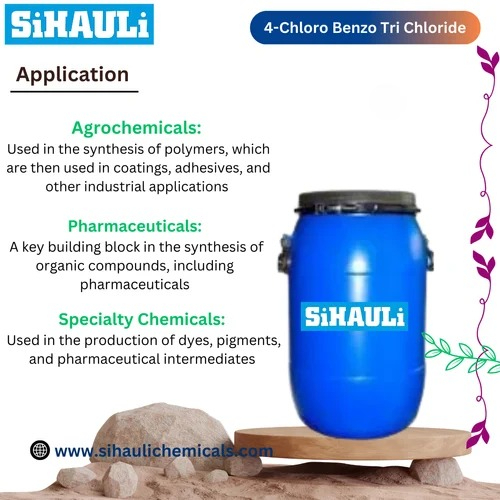
4-chloro benzotrichloride" refers to a chemical compound, also known as p-chlorobenzotrichloride, which is a colorless, flammable liquid with the formula C7H4Cl4, where a chlorine atom is substituted at the para position on a benzene ring attached to a trichloromethyl group; it's primarily used as a key intermediate in organic synthesis, particularly for producing pharmaceuticals and agrochemicals due to its reactive nature.Industrial Applications of 4-Chloro Benzo Tri Chloride4-Chloro Benzo Tri Chloride is widely employed as an intermediate in the production of pharmaceuticals, dyes, agrochemicals, and various organic compounds. Its chemical stability and solubility in multiple organic solvents make it ideal for complex syntheses in research and industrial chemical manufacturing. This versatility supports diverse formulations, enhancing efficiency across industries.
Safe Handling and Storage GuidelinesDue to its classification as a toxic substance and water-reactive properties, 4-Chloro Benzo Tri Chloride should be handled only in well-ventilated areas while using appropriate personal protective equipment. Store the product in tightly sealed HDPE drums, in a cool, dry, well-ventilated area isolated from moisture and incompatible substances to maintain stability and prevent hazardous decomposition.
Packaging and Shelf Life InformationThe compound is primarily packaged in robust HDPE drums, although customized packaging options are available upon request. Under optimal storage conditions, its shelf life is approximately 12 months in unopened containers, ensuring product integrity and usability throughout the supply chain. Proper packaging safeguards the compound's quality during transport and storage.
FAQ's of 4-Chloro Benzo Tri Chloride:
Q: How should 4-Chloro Benzo Tri Chloride be safely handled in an industrial setting?
A: 4-Chloro Benzo Tri Chloride should be handled in areas with adequate ventilation, using appropriate personal protective equipment such as gloves, goggles, and protective clothing. Avoid exposure to moisture and ensure that handling takes place away from heat or ignition sources due to its toxicity and water reactivity.
Q: What is the main use of 4-Chloro Benzo Tri Chloride in chemical manufacturing processes?
A: This compound is primarily used as an intermediate in the synthesis of pharmaceuticals, agrochemicals, dyes, and other specialized organic chemicals, owing to its reactive acyl chloride group and reliability in complex organic reactions.
Q: When does 4-Chloro Benzo Tri Chloride become hazardous, and what are the potential risks?
A: 4-Chloro Benzo Tri Chloride becomes hazardous if exposed to water, as it releases hydrogen chloride gas. Under fire conditions, it may decompose to form toxic substances like hydrogen chloride, phosgene, and chlorine, so it is crucial to store and handle it according to safety procedures.
Q: Where should 4-Chloro Benzo Tri Chloride be stored for maximum stability and safety?
A: The product should be stored in tightly closed HDPE drums, placed in a cool, dry, well-ventilated location away from sources of moisture and incompatible chemicals to maintain its stability and prevent dangerous reactions.
Q: What is the standard packaging for 4-Chloro Benzo Tri Chloride and can it be customized?
A: Standard packaging consists of HDPE drums, designed to withstand chemical exposure and protect against leaks. However, packaging can be customized to meet specific customer requirements for volume or logistics.
Q: How should 4-Chloro Benzo Tri Chloride be transported and what are its hazard classifications?
A: It must be transported as a Class 6.1 (toxic substance) under UN Number 3256, with precautions to minimize risks of spillage, leakage, and exposure. Proper labeling and documentation in compliance with international transport regulations are required.
Q: What benefits does 4-Chloro Benzo Tri Chloride offer as an industrial intermediate?
A: Its high purity (99%), good chemical stability, and efficacy as an acylation agent in organic synthesis make it valuable for producing high-quality pharmaceuticals, dyes, and agrochemicals, streamlining various manufacturing processes.








 Send Inquiry

