Diglyme (Bis(2-MethoxyEthyl) Ether) About
| Purity |
99 % |
| Grade |
Reagent Grade,Industrial Grade |
| Usage/Application |
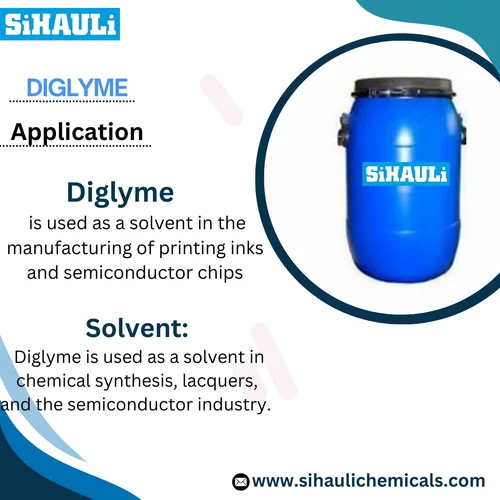
Solvent: Diglyme is used as a solvent in chemical synthesis, lacquers, and the semiconductor industr |
| Packaging Type |
Drum |
| Physical Form |
Liquid |
| Chemical Formula |
C6H14O3 |
| CAS Number |
111-96-6 |
| Molecular Weight |
134.18 g/mol |
Diglyme, or bis(2-methoxyethyl) ether, is an organic compound with the chemical formula (CH3OCH2CH2)2O. It is a colorless liquid with a slight ether-like odor. It is a solvent with a high boiling point. It is the dimethyl ether of diethylene glycol.
Versatile Solvent for Industrial and Laboratory ApplicationsDiglyme acts as a highly efficient solvent for a wide range of chemical reactions, including organometallic and catalytic processes. Its compatibility with both aqueous and organic phases enhances its utility in the pharmaceutical and electronics sectors. By offering excellent solubility and thermal stability, Diglyme supports precise and consistent results in demanding laboratory procedures.
Safe Storage and Handling GuidelinesDue to its classification as a Class 3 flammable liquid, Diglyme should be stored in cool, dry, and well-ventilated areas, away from heat sources and open flames. Users must employ adequate ventilation when handling this solvent to minimize exposure risks. Following proper safety protocols ensures a safe working environment and preserves the product's shelf life of up to 24 months.
FAQ's of Diglyme (Bis(2-MethoxyEthyl) Ether):
Q: How should Diglyme be safely stored and transported?
A: Diglyme should be stored in tightly sealed containers in a cool, dry, and well-ventilated area, away from heat, sparks, and open flames. For transportation, it is classified under UN 1161, Hazard Class 3, meaning it should be handled as a flammable liquid according to regulatory protocols.
Q: What are the primary applications of Diglyme in industry and laboratories?
A: Diglyme is widely used as a solvent for chemical syntheses, as an electrolyte component in batteries, and in pharmaceutical formulations. Its high solubility and stability make it valuable for reactions requiring miscibility with water and organic solvents.
Q: When is Diglyme preferred over other solvents?
A: Diglyme is chosen when a process requires a neutral, high-purity, and thermally stable solvent that is compatible with both water and many organic compounds. Its excellent miscibility and high boiling point are particularly beneficial in pharmaceutical and organic synthesis applications.
Q: Where can Diglyme be sourced for industrial use?
A: Diglyme can be obtained from specialized chemical exporters, importers, manufacturers, and suppliers, particularly in industrial regions of India. Packaging options typically include drums or bottles, with customizable sizes available to meet different requirements.
Q: What safety precautions should be observed when using Diglyme?
A: When working with Diglyme, it is essential to avoid sources of heat, sparks, and open flames due to its flammability. Adequate ventilation must be maintained to minimize inhalation exposure, and appropriate personal protective equipment should be used during handling.
Q: How does Diglyme benefit chemical processes and product formulations?
A: Diglyme enhances chemical processes by enabling the dissolution of a wide array of reactants, ensuring homogeneous reactions. Its thermal stability and inertness contribute to high yields and purity in both industrial and laboratory-scale syntheses.





 Send Inquiry

